
How Mercedes-Benz Tests the 2027 GLB in Extreme Winter Conditions
December 10 2025,
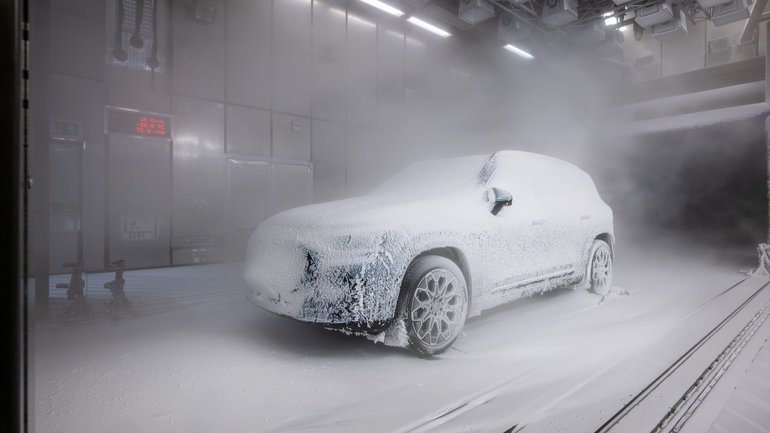
Mercedes-Benz engineers are pushing the all-new 2027 GLB through rigorous cold-weather testing at the Mercedes Technology Center in Sindelfingen, Germany. Inside two state-of-the-art climatic wind tunnels, the compact SUV faces temperatures as low as -40°C and simulated blizzards with snowflakes racing at speeds up to 200 km/h. These extreme tests will ensure the GLB delivers the confident traction, thermal comfort, and clear visibility Ottawa drivers need during harsh Canadian winters.
The testing program validates every aspect of winter performance—from windshield defrosting capability to climate control efficiency. Engineers monitor how swirling snow affects air inlets, verify wiper function in severe weather, and measure how quickly the cabin reaches comfortable temperatures. For families in Ottawa facing unpredictable winter conditions, this comprehensive testing process confirms the GLB will be ready for real-world driving challenges.
Inside the Cold Chamber: Simulating Arctic Conditions
The cold tunnel at the Mercedes Technology Center can generate temperatures ranging from -40°C to 40°C. Advanced snow cannons produce various snow types across this temperature range, while high-powered fans create fierce blizzards that propel snowflakes toward test vehicles at speeds reaching 200 km/h.
A rolling road inside each tunnel simulates actual driving conditions. Powerful electric motors drive four rollers, allowing 4MATIC all-wheel-drive models to be tested under realistic load. The test rigs handle vehicles with up to 1,046 hp and enable top speeds of 265 km/h. Vehicles can be refueled and charged without leaving the controlled environment.
From a fully insulated control room, technicians regulate temperature, humidity, wind speed, and other parameters with precision. Large observation windows allow close monitoring of each test. Unlike road testing, these controlled conditions produce reproducible measurements—engineers can repeat identical tests to verify improvements and ensure consistent quality.
Windshield Defrosting and Visibility Testing
Clear visibility is essential in winter driving. Inside the cold tunnel, engineers verify the GLB's climate control system can quickly defrost an icy windshield without driver intervention. A camera records the entire de-icing process during testing.
At an outside temperature of -15°C, the GLB will clear its windshield for safe driving in just 15 minutes using only the defrost setting—no manual wiper activation required. This performance will ensure drivers in Ontario can start their morning commute without lengthy warm-up delays.
Engineers also test windshield wiper function across all weather conditions. They examine whether swirling snow can block the vehicle's air inlets, replicating the spray from passing trucks on Highway 417. These detailed checks confirm every component will perform reliably when winter conditions turn severe.
Heating Efficiency: Twice as Fast as Previous Generation
The all-new GLB will deliver significantly improved cabin heating. During a 20-minute drive in -7°C ambient temperatures, the climate control will heat the interior twice as fast as its predecessor—and even faster than a traditional gasoline-powered vehicle. This rapid heating will require only about half the energy compared to the previous GLB, helping maximize electric range.
The cabin heating process will start automatically when someone enters the vehicle. Mercedes-Benz employs a strategy to first warm the upper body and hands of occupants, ensuring rapid thermal comfort even without pre-conditioning. The climate control system will regulate heating and cooling seamlessly through its intelligent, predictive operating strategy.
An innovative heat pump adapted from the VISION EQXX technology program is central to this system. As a multi-source heat pump, it can use three energy sources in parallel: waste heat from the electric drive, battery, and ambient air. By using this "free" heat, the heat pump will manage this process with approximately one-third of the electrical energy that a comparable auxiliary heater would require for the same output.
Heat Chamber Testing: Preparing for Summer Extremes
While winter testing validates cold-weather performance, the heat chamber ensures the GLB will handle extreme heat with equal capability. Temperatures ranging from -10°C to 60°C can be generated inside this tunnel.
A solar simulation system with 32 lamps delivers a radiation spectrum matching natural sunlight. Over an approximately 8 by 2.4-metre area, radiation intensity varies between 200 and 1,200 watts per square metre. The highest level replicates conditions in remote deserts like Death Valley.
The "Hot Road" feature simulates a road surface with temperature continuously adjusted between 50°C and 70°C. This precision replicates the thermal conditions of pavement on a scorching summer day, creating conditions as close to real-world driving as possible.
Advanced Interior Features Tested Under Pressure

The all-new GLB's interior will undergo the same rigorous testing as its mechanical systems. The optional MBUX Superscreen will extend across the entire width of the dashboard, integrating seamlessly with circular climate control air vents finished in Silver Shadow.
The standard panoramic roof will include a special coating on the interior surface. This LowE (low-emissivity) coating serves dual purposes: it provides heat protection for the cabin in warm weather, and in winter, it reduces heat loss by reflecting interior heat back into the cabin. At only 200 nanometres thick—thinner than a human hair—this infrared film delivers significant thermal benefits without compromising visibility.
Available as an option, the panoramic roof's transparency can be changed segment by segment in 10 to 20 milliseconds. Drivers will be able to use the central multimedia display to switch between transparent for a clear view above and "opal" (translucent) for improved glare protection in direct sunlight. The large panoramic roof will also be available with optional ambient lighting featuring a luminous starry sky.
MB.OS and MBUX: Intelligence That Adapts
The Mercedes-Benz Operating System (MB.OS) supercomputer will power the all-new GLB with advanced computing capability. Combined with the fourth generation MBUX, the latest operating concept will deliver redesigned welcome animations, an advanced Zero Layer function, and an extensive range of apps.
The MBUX Virtual Assistant will feature different avatars and will be powered by generative artificial intelligence. Navigation will be provided by Google Maps, complemented by powerful MBUX Surround Navigation. MB.OS will enable the latest MB.DRIVE driver assistance systems, with the all-new GLB coming standard with an extensive range of driver assistance technologies, including Digital Extra: Distance Assist DISTRONIC.
The vehicle will be equipped with eight cameras, five radar sensors, 12 ultrasonic sensors, and a water-cooled high-performance supercomputer. This hardware provides sufficient power reserves for future functions and regular over-the-air updates, ensuring the GLB will continue to improve throughout its ownership lifecycle.
Experience the All-New GLB at Mercedes-Benz Ottawa Downtown
The all-new Mercedes-Benz GLB will combine rigorous engineering validation with intelligent technology designed for real-world driving in Ontario. From extreme cold-weather testing in wind tunnels to advanced heat pump systems that maximize efficiency, every detail has been refined to deliver the comfort and capability families in Ottawa expect from the three-pointed star.
Contact Mercedes-Benz Ottawa Downtown to be among the first to know when the 2027 GLB arrives. Our team will be ready to walk you through the MBUX Superscreen, explain the multi-source heat pump system, and help you explore seating configurations that match your family's needs.